Data Centres, Cloud Platforms to Power India’s $1.46 Tn Digital Economy by FY30
ECONOMY & POLICY

Data Centres, Cloud Platforms to Power India’s $1.46 Tn Digital Economy by FY30

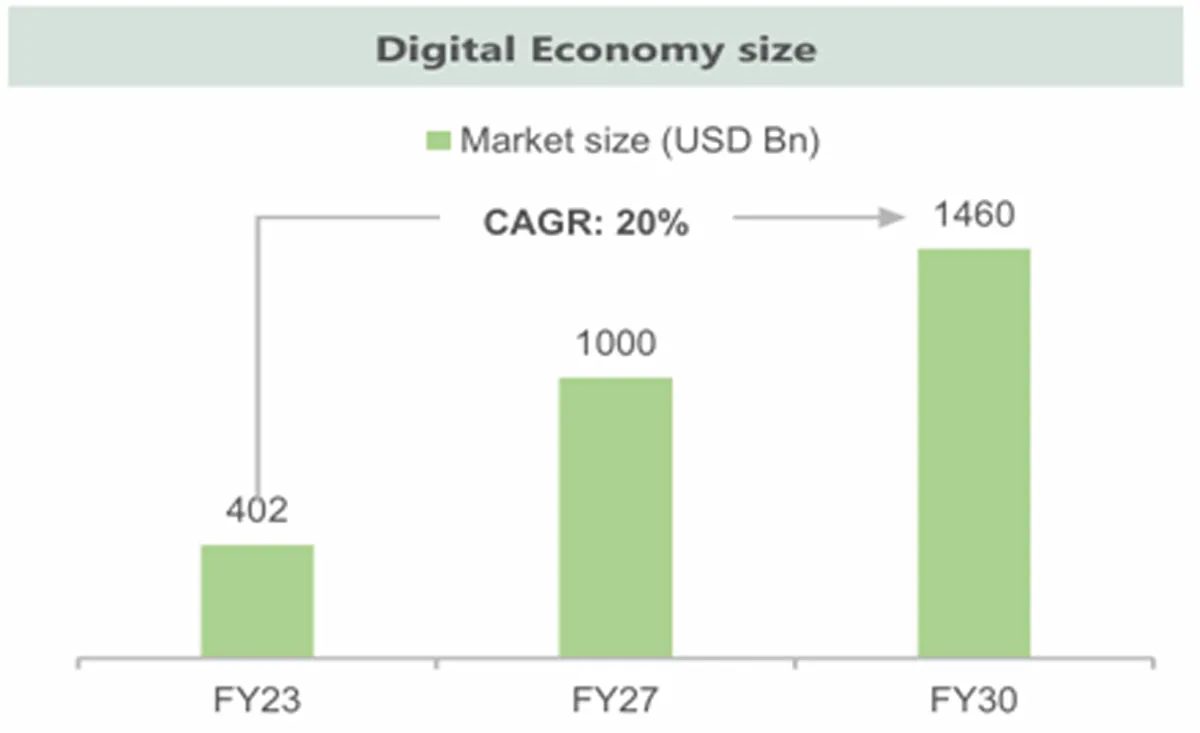
India’s data centre and cloud ecosystem is set to become the backbone of the country’s $1.46 trillion digital economy by FY30, according to a report by Equirus Capital. The study highlights how colocation and cloud services are enabling scalable, secure digital infrastructure for enterprises, hyperscalers, and government initiatives under India’s $1 trillion Digital Economy Mission. 

The digital ecosystem rests on five key layers — hardware infrastructure, foundational AI models, real-world AI applications, data centres and hyperscalers, and data governance. Among these, data centres and cloud platforms are driving capacity creation and economic acceleration. 

India’s data centre capex is projected to rise from Rs 175 billion in 2024 to Rs 575 billion by 2030, reflecting a 23 per cent CAGR. Despite this expansion, demand continues to outpace supply — capacity rose 50 per cent from 75 MW to 114 MW in a year, while demand surged over 50 per cent from 81 MW to 122 MW. 

Key growth drivers include exponential data consumption, rapid enterprise cloud adoption, policy support under Digital India, and data localisation mandates. Generative AI, IoT, and edge computing are also contributing to rising processing and storage needs. 

Emerging players such as Adani Connex, Nxtra, and Yotta are expected to lead capacity additions, contributing around 860 MW to India’s growing base of 1.3 GW, taking total installed capacity beyond 2.9 GW. 

India’s data centre and cloud ecosystem is set to become the backbone of the country’s $1.46 trillion digital economy by FY30, according to a report by Equirus Capital. The study highlights how colocation and cloud services are enabling scalable, secure digital infrastructure for enterprises, hyperscalers, and government initiatives under India’s $1 trillion Digital Economy Mission. The digital ecosystem rests on five key layers — hardware infrastructure, foundational AI models, real-world AI applications, data centres and hyperscalers, and data governance. Among these, data centres and cloud platforms are driving capacity creation and economic acceleration. India’s data centre capex is projected to rise from Rs 175 billion in 2024 to Rs 575 billion by 2030, reflecting a 23 per cent CAGR. Despite this expansion, demand continues to outpace supply — capacity rose 50 per cent from 75 MW to 114 MW in a year, while demand surged over 50 per cent from 81 MW to 122 MW. Key growth drivers include exponential data consumption, rapid enterprise cloud adoption, policy support under Digital India, and data localisation mandates. Generative AI, IoT, and edge computing are also contributing to rising processing and storage needs. Emerging players such as Adani Connex, Nxtra, and Yotta are expected to lead capacity additions, contributing around 860 MW to India’s growing base of 1.3 GW, taking total installed capacity beyond 2.9 GW. 

Next Story
Infrastructure Urban

ABB to Invest Rs 6.25 Billion to Expand India Manufacturing

ABB recently announced plans to invest approximately Rs 6.25 billion ($75 million) in India during 2026 to expand its manufacturing footprint and research and development capabilities. The investment follows more than $35 million spent in 2025 and reflects the company’s continued focus on strengthening its ‘local-for-local’ strategy in the country.The investment will support ABB’s Electrification, Motion and Automation businesses and expand manufacturing capacity for infrastructure sectors such as renewable energy, metro rail, data centres and industrial applications. Approximately 300..

Next Story
Equipment

Six WOLFF Cranes Handle 60,000 m³ Concrete for German Hospital

Six WOLFF tower cranes are playing a key role in constructing a new hospital complex in Memmingen, Germany, supporting large-scale material handling for the project. The facility is being built on a 7.7-hectare site and will feature six floors, around 480 beds and a gross floor area exceeding 75,000 sq m.Building shell works began recently in February 2025. One WOLFF 6531.12 Cross crane supported early site preparation before being dismantled in autumn 2025, while five remaining cranes continue operations. Over an average deployment period of 16 months, the cranes are expected to move approxim..

Next Story
Equipment

REC Funds Rs 115.6 Million CSR Support for Bihar Eye Hospital

REC recently committed Rs 115.6 million under its Corporate Social Responsibility (CSR) programme for the procurement of clinical and non-clinical equipment at Sankara Eye Hospital in Saharsa, Bihar. The initiative aims to strengthen healthcare infrastructure and improve access to specialised eye care services in the region.A Memorandum of Agreement (MoA) was recently signed between Pradeep Fellows, Executive Director (CSR), REC Limited, and Wg Cdr V. Shankar (Retd), Trustee and Executive Director of Sankara Eye Hospital, at the REC office in the SCOPE Complex, New Delhi.The support is expecte..

Advertisement

Subscribe to Our Newsletter

Get daily newsletters around different themes from Construction world.

STAY CONNECTED

Advertisement

Advertisement

Advertisement